WASHINGTON — Senator Lindsey Graham, a long-serving Republican from South Carolina who evolved from one of Donald Trump’s most vehement critics into one of his most powerful and steadfast legislative allies, died on Saturday. He was 71 years old. According to an official statement released by his office early Sunday morning on social media, Graham’s passing followed a “brief and sudden” illness. The statement added, “Senator Graham’s family appreciates prayers at this time and asks for privacy during this incredibly difficult period.”
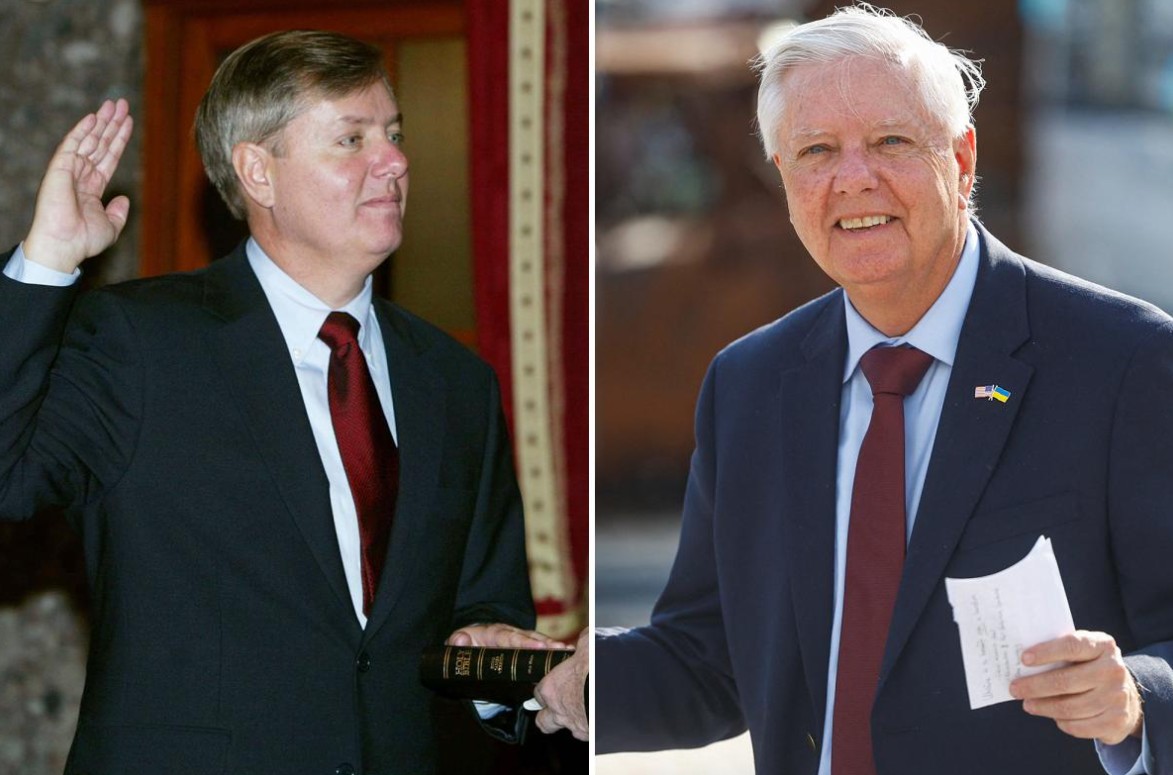
Following the announcement, the D.C. Medical Examiner’s office released preliminary findings regarding the cause of death, identifying it as an Aortic Dissection stemming from Arteriosclerotic Cardiovascular disease. As a mark of respect for the late lawmaker, the American flags flying above the White House and on the White House North Lawn flagpole were promptly lowered to half-staff.
The news of his sudden death sent shockwaves through the nation’s capital and his home state of South Carolina. Former President Donald Trump expressed his grief on social media Sunday morning, writing: “Senator Lindsey Graham, one of the greatest people and Senators I have ever known, is dead! He was always working, and was a true American Patriot. Lindsey will be greatly missed!!!” In South Carolina, Governor Henry McMaster stated that he and his family were “devastated” by the loss, posting on X that Graham was “the fiercest of fighters for South Carolina and America — and a loyal and steadfast friend… We shall not see his likes again.”
The Political Metamorphosis and Video
To understand Lindsey Graham’s legacy is to examine one of the most remarkable political transformations in modern American history. During the 2016 Republican presidential primary campaign, Graham was an outspoken opponent of Donald Trump. He ran against Trump in the primaries before withdrawing early due to low polling numbers. During that contentious election cycle, Graham did not mince words, famously branding Trump as “a kook,” “crazy,” and “unfit for office.”
Lindsey Graham Ladybugs Video
However, pragmatism and a shared vision for conservative governance eventually reshaped their dynamic. Over the decade that followed, Graham underwent a profound metamorphosis, shifting from a fierce detractor into one of the president’s closest confidants and strongest defenders in the upper chamber of Congress. They became regular golfing partners—a relationship Graham reflected on fondly in March 2025: “On a professional level, I am proud to have been there at the beginning when President Trump — through sheer force of will — achieved the greatest political comeback in American history. On a personal level, I genuinely enjoy our friendship. He’s an awesome golfing buddy, who I have yet to beat.”
This alliance remained powerful until his final days. Trump recently endorsed Graham in his primary campaign, helping him sail to victory with nearly 57% of the vote against several challengers. Trump even held a tele-rally to bolster Graham’s campaign, demonstrating the strength of their political partnership. Graham was fully slated to appear on the ballot for reelection this coming November and had expressed confidence that their lockstep collaboration would continue well into the future.
Legislative Legacy and Shaping the Federal Judiciary
First elected to the Senate in 2002 after serving four terms in the House of Representatives representing South Carolina’s 3rd congressional district, Graham spent 23 years rising to become one of the most influential figures in Washington. His committee assignments were vast and powerful, spanning the Appropriations, Budget, Judiciary, and Environment and Public Works committees.

As the current chair of the Senate Budget Committee, Graham wielded significant fiscal influence. He recently utilized this role to lead the Senate’s efforts in passing a major $70 billion budget reconciliation bill designed specifically to provide robust funding for border security—a key legislative priority that Trump signed into law.
However, Graham’s most enduring domestic legacy lies in his decades-long work on the Senate Judiciary Committee, where he served continuously since joining the chamber in 2003. From 2019 to 2022, he helmed the powerful panel as its chairman. Under his leadership, the committee successfully molded the landscape of the federal judiciary by advancing numerous conservative judges to the federal bench.
Most notably, following the death of Justice Ruth Bader Ginsburg in the closing months of Trump’s first presidential term, Graham guided the committee through the incredibly swift and contentious confirmation of Supreme Court Justice Amy Coney Barrett. This marked a stark contrast to his actions four years prior, when he was among the key Senate Republicans who successfully blocked President Barack Obama’s nomination of Merrick Garland to fill the vacancy left by the late Justice Antonin Scalia, nearly 11 months before the 2016 election. Had he won reelection this fall, Graham was poised to return as the chairman of the Judiciary Committee. He recently noted his unyielding drive for the role, stating: “I’ll wake up every morning and go to bed every night, thinking, ‘How many judges can we put on the bench before Trump leaves…’”
A Foreign Policy Hawk on the Global Stage
Beyond domestic courts and budget battles, Graham was widely recognized as a staunch foreign policy hawk. He frequently advised the White House on international matters and was highly vocal in his defense of aggressive American foreign policy. He strongly backed the administration during recent geopolitical conflicts, including defending actions regarding the war in Iran and supporting the strategic decision to lead military strikes on Iranian nuclear sites. Trump himself praised this tough partnership during a campaign rally, stating that he and Graham made a “very tough team” determined to prevent Iran from acquiring nuclear weapons.
Simultaneously, Graham maintained an unwavering commitment to supporting Ukraine against Russian aggression, fostering a strong and at times intense relationship with Ukrainian President Volodymyr Zelenskyy. Graham consistently pushed for robust military aid, advanced weaponry, and financial assistance for the embattled nation.
Just days before his sudden passing, Graham made his 10th official visit to Ukraine, where he met with Zelenskyy and toured a local drone manufacturing facility. On July 7, Graham remarked, “In my opinion, this summer is the time to go all in to put pressure on Putin to get to the peace table and end the bloodbath.” By Friday, he and a bipartisan group of senators had successfully finalized a bipartisan deal with the White House on a Russia-sanctions bill that Graham had long championed. Upon hearing of his death, President Zelenskyy expressed deep sadness, calling Graham a “true defender of freedom,” a “staunch advocate,” and a “determined leader.”
Graham’s hawkish stance and diplomatic outreach also extended to the Middle East, where he maintained close ties with Israel. Reacting to the news, Israeli Prime Minister Benjamin Netanyahu released a statement mourning the senator: “Israel has lost one of its greatest friends. America has lost a great patriot. I have lost a beloved friend.”
Over Three Decades in Washington: Bipartisan Roots and Conflict
Graham’s 30-plus years in Washington were defined by a unique willingness to spar with presidents of both parties while occasionally seeking bipartisan consensus. Entering the national spotlight after the 1994 Republican revolution, Graham served as an impeachment manager in the 1998 House proceedings against President Bill Clinton. Years later, he would become a fierce critic of the Obama administration.
Yet, Graham also possessed a bipartisan streak that surprised many. In 2013, he worked across the aisle as part of a bipartisan coalition to draft a comprehensive immigration reform bill. The legislation sought to combine increased border security infrastructure with a definitive pathway to citizenship for certain undocumented immigrants, though the bill ultimately failed to become law. Furthermore, despite his intense political opposition to President Joe Biden, Graham maintained a warm, longtime personal friendship with Biden, rooted in their many shared years serving together in the Senate chamber.
Early Life, Military Career, and Personal Profile
Lindsey Olin Graham’s journey to the upper echelons of American power began from humble, blue-collar roots. Born on July 9, 1955, in Central, South Carolina—a small town that housed little more than a thousand residents at the time—his parents ran a modest local restaurant and pool hall. Tragedy struck early in his life when both of his parents passed away, forcing a young Graham to step up as the legal guardian to raise his younger sister.
He became the very first member of his family to attend college, successfully earning both his undergraduate degree and his law degree from the University of South Carolina, graduating from law school in 1981. The following year, Graham joined the United States Air Force, embarking on a long military career as a judge advocate (JAG). He served on active duty overseas in Germany from 1984 to 1988 before transitioning to the reserves.
As a military reservist, Graham was called back to active duty state-side during the First Gulf War. He continued his service in the Air Force Reserve for decades, eventually retiring in June 2015 at the prestigious rank of colonel. Throughout his life, Graham resided in Seneca, South Carolina. He never married and was a dedicated member of the Corinth Baptist Church.
The death of Lindsey Graham marks the definitive end of an era in the United States Senate. For years, Graham was part of a famous, globe-trotting Senate triumvirate alongside the late Republican Senator John McCain, who died in 2018, and the late Independent Senator Joe Lieberman, who passed away in 2024. Dubbed the “Three Amigos,” the trio traveled the world together to project American leadership. Reflecting on their bond in 2018, Graham had said, “I’ve seen these guys in action… I’ve learned a lot from both of them and we had so much fun.” With Graham’s passing, the final member of that influential circle has gone silent.
As the Senate prepares to return from its Fourth of July recess on Monday—the final legislative block where Graham had cast his last vote on June 24—colleagues are left to mourn a massive void. Senate Majority Leader John Thune summarized the heavy heart of the chamber, stating: “As South Carolina’s senior senator, Lindsey fought passionately for the Palmetto State. He was a trusted adviser and colleague to me and many others, and numerous presidents and heads of state have relied on his counsel. His influence on the federal judiciary, our national defense, and his beloved South Carolina will be felt for generations.”